JSON That Thinks: A Programming Language Inside JSON
What if JSON wasn't just a data format?
What if it was a programming language?
We built a Turing-complete language that is a strict subset of JSON. No new syntax. No custom parser. Every program is valid JSON.
This is Almadar.
The Core Idea
In 1958, John McCarthy introduced S-expressions in Lisp:
(+ 1 2)
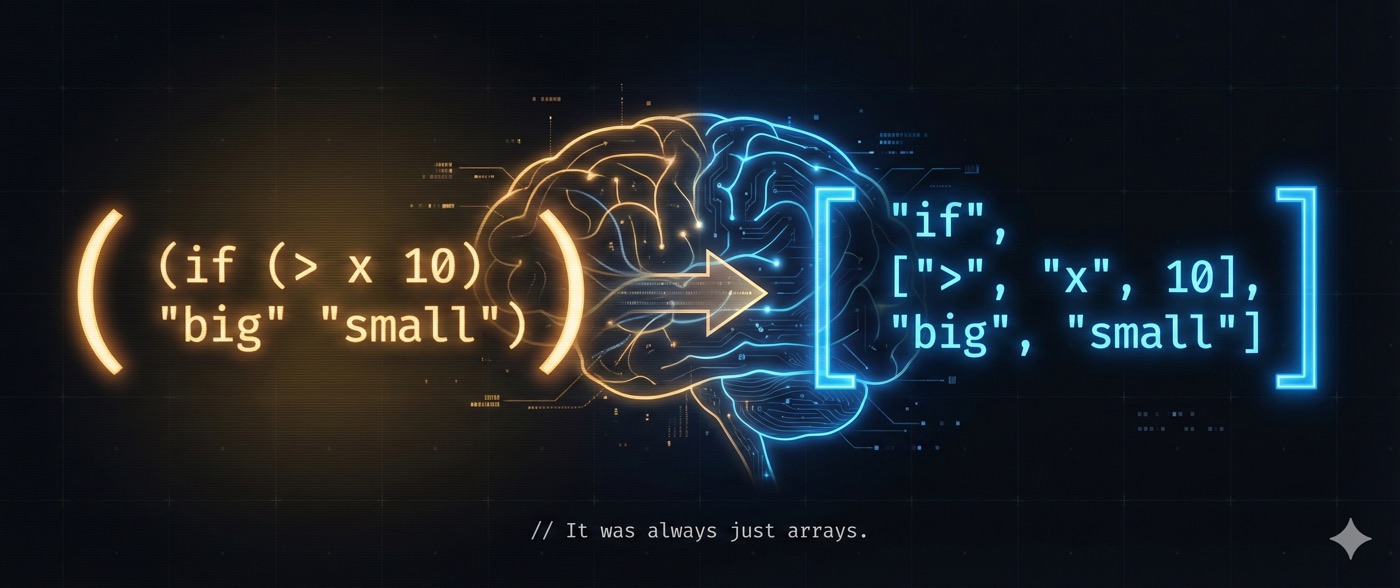
(if (> x 10) "big" "small")S-expressions are nested lists where the first element is the operator.
JSON arrays are nested lists.
["+", 1, 2]
["if", [">", "x", 10], "big", "small"]That's it.
S-expressions already fit perfectly inside JSON arrays. Instead of inventing new syntax, we interpret what JSON already expresses.
What an Almadar Program Looks Like
An Almadar program is composed of Orbitals — the basic building blocks of the system.
Each Orbital encapsulates three core elements:
- Entity — the data model
- Trait — the behavior
- Page — the UI
Entity — The Data Model
The Entity defines the structure of data. It declares fields, types, and constraints.
It is:
- The schema
- The memory
- The state container
It holds the data the system operates on.
Trait — The Behavior
A Trait defines behavior.
Technically, a Trait is a reusable state machine linked to an Entity.
It contains:
- States
- Transitions
- Guards (conditions written as S-expressions)
- Effects (actions like
set,emit, etc.)
Traits encapsulate logic and can be reused across orbitals. They are the computational core of the system.
Page — The UI
A Page defines the user interface.
It describes:
- Layout
- Components
- Bindings to entity fields
- Event triggers
Pages react to entity state and dispatch events that drive Traits.
Example
{
"name": "ApprovalWorkflow",
"orbitals": [{
"entity": {
"name": "Request",
"fields": [
{ "name": "amount", "type": "number" },
{ "name": "status", "type": "enum", "values": ["pending", "approved", "rejected"] }
]
},
"traits": [{
"name": "ApprovalTrait",
"linkedEntity": "Request",
"stateMachine": {
"states": [
{ "name": "Pending", "isInitial": true },
{ "name": "Approved" },
{ "name": "Rejected" }
],
"transitions": [{
"from": "Pending",
"to": "Approved",
"event": "APPROVE",
"guard": ["and",
[">=", "@user.roleLevel", 3],
["<", "@entity.amount", 10000]
],
"effects": [
["set", "@entity.status", "approved"],
["emit", "REQUEST_APPROVED"]
]
}]
}
}]
}]
}Structure is JSON. Logic is JSON arrays. Execution is deterministic and recursive.
What Is a Guard?
A guard is a conditional expression that determines whether a state transition is allowed to execute.
A transition only fires if its guard evaluates to true.
If the guard evaluates to false, the transition is blocked.
Guards are pure expressions — they have no side effects.
Guard Example
{
"from": "Pending",
"to": "Approved",
"event": "APPROVE",
"guard": ["and",
[">=", "@user.roleLevel", 3],
["<", "@entity.amount", 10000]
],
"effects": [
["set", "@entity.status", "approved"]
]
}This transition runs only if:
- The user's role level is at least 3
- The request amount is less than 10,000
If either condition fails, the transition does nothing.
Guard Evaluation
Guards are evaluated recursively:
["and",
[">=", "@user.roleLevel", 3],
["<", "@entity.amount", 10000]
]Evaluation steps:
- Resolve bindings (
@user.roleLevel,@entity.amount) - Evaluate inner expressions
- Evaluate the outer operator
The result must be a boolean.
Guards can use:
- Logical operators:
and,or,not - Comparisons:
=,!=,<,>,<=,>= - Arithmetic
- Nested expressions
- References to
@entity,@user, or@payload
Conceptually, a guard is the equivalent of an if condition for a transition.
Why This Is a Programming Language
Almadar is Turing-complete because it provides:
- Mutable state (entity fields)
- Deterministic state machines
- Conditional logic
- Effects (
set,emit) - Self-transitions (loops)
- Event-driven communication
A self-transition with a guard and state updates is equivalent to a while loop:
{
"from": "Computing",
"to": "Computing",
"event": "TICK",
"guard": [">", "@entity.counter", 0],
"effects": [
["set", "@entity.counter", ["-", "@entity.counter", 1]],
["emit", "TICK"]
]
}State = memory. Transitions = control flow. Expressions = computation.
That's a complete computational model.
The Proposal
Almadar proposes a simple shift:
- Keep JSON.
- Interpret arrays as S-expressions.
- Combine them with state machines for control flow.
- Treat structured data and executable logic as one system.
No new grammar. No new syntax rules. Just structured computation inside the world's most universal data format.
JSON already won.
Now it can think.